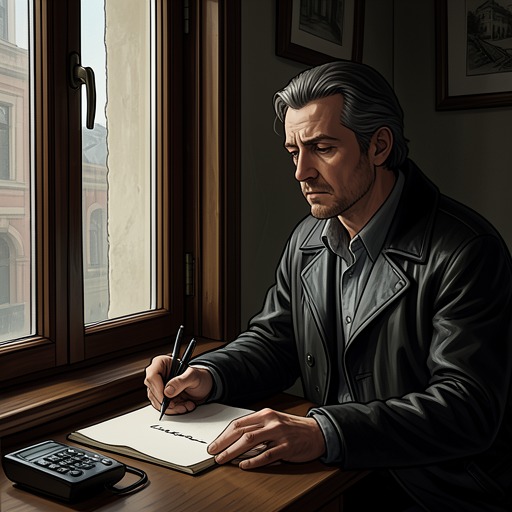
Arthur Leander–Victoria relationship
Station ElevenArthur Leander and Victoria’s relationship is a childhood friendship that survives for years in Arthur’s letters, even as the correspondence reveals how little he knows about Victoria’s life. He remembers her as a companion from the island and keeps addressing her as a confidante after moving away, but his repeated efforts to reach her are not matched by hers. When their connection resurfaces decades later, Arthur wants to begin again; the letters he sent are eventually published without his permission, making the imbalance he once failed to see part of his public story.
Childhood Friendship and Distance
Arthur and Victoria grew up together on an island. Arthur recalls building forts with her in the woods when they were five, and describes walking on the beach with his best friend as one of the true experiences that, from a distance, can begin to seem like a fairy tale. As an adult living in Toronto, he feels the island receding into a past that seems almost unreal. He imagines Victoria still there, and the contrast between her rooted life and his departure becomes a recurring measure of how far they have moved apart.
His letters preserve small, specific memories of their intimacy. Arthur remembers playing mah jong at Victoria’s house with her mother, a rare occasion made vivid by the little tiles and by the fact that both friends were stoned. He also remembers the view from the living room: the ocean seemed to meet the lawn, but outside a cliff intervened, reached by a rickety staircase that frightened him. In another letter, he asks whether Victoria remembers the cold March night when they watched Comet Hyakutake together, whispering its name and watching its light hang in the sky. These recollections show what he hopes the friendship can still hold: a shared past that remains vivid even when they no longer share a present.
Arthur’s Letters from Toronto
After leaving the island, Arthur writes to Victoria from Toronto while attending an acting class. He tells her about Clark Thompson, a fellow student with half-shaved, pink-dyed hair whose parents want him to pursue a practical degree. Arthur understands Clark’s resistance because he remembers his own wish to escape the island rather than remain there and drive his father’s snowplow. The exchange makes Victoria the person to whom Arthur explains his new life and the choices that separate him from home.
His accounts of acting reveal a second kind of distance: the gap between what he wants to become and what he can yet do. After an instructor tells him that his acting is flat, Arthur challenges the judgment and keeps working. When the instructor later watches his monologue attentively and offers a goodnight after weeks of ignoring him, Arthur feels a small renewal of hope. He describes himself as able to recognize good acting but unable to reach it, though sometimes close. He shares the setback and the fragile encouragement with Victoria, as if her attention might help make his ambition real.
The letters also register loneliness and a shifting sense of home. Arthur says that the island has become like a dream, while Toronto’s streets, parks, clubs, and crossings feel immediate; he imagines that a person understands the city best by becoming penniless and walking everywhere. At nineteen, he wants to become a good actor and do something remarkable, and is considering auditioning for an acting program in New York. Yet the person he most wants to tell these things to does not answer regularly. He notes that Victoria has not answered for four months and has not sent anything longer than a postcard in five. His longing for the friendship is therefore inseparable from his growing awareness that the relationship is not being sustained in the same way by both people.
Unequal Correspondence
Arthur eventually puts the imbalance into direct terms. He believes Victoria will return his calls if he calls first, but will never initiate contact herself. Although she has said they would always be friends, he has begun to doubt that her actions support the promise. A friend, Clark, thinks Arthur expects too much from friendship, but Arthur remains hurt by always having to come to Victoria. The letters thus turn from reports of his life into an attempt to name what is failing between them.
The imbalance is not absolute: early in Arthur’s time away, Victoria sends him a couple of letters and several postcards. Later she sends brief notes to tell him she has changed addresses. But Arthur’s subsequent recollection of the correspondence is that she wrote little, while he continued to use the letters to share thoughts and memories. That difference matters to his later confession. His attachment to Victoria is genuine, but writing to her does not mean he has attended to her as an independent person with a life of her own.
Reunion and the Published Letters
Years, perhaps decades, pass before Arthur writes again. After seeing Victoria at Christmas, he tells her that the encounter was awkward but wonderful and that he has missed talking with her. He learns that she has four children, news that emphasizes how much of her adult life he has not known. He also has major news of his own: he is getting married to Miranda Carroll, an artist from the island whom he met in Toronto. Miranda makes comic strips, and she is preparing to move with Arthur to Los Angeles. He asks whether they can be friends again, treating the reunion as a chance to reopen a bond that his earlier letters had not repaired.
That private correspondence later becomes the basis of Dear V.: An Unauthorized Portrait of Arthur Leander. Before publication, Elizabeth Colton tells Clark Thompson that she has learned they are both discussed in the book. She is furious and considers legal action, though she is unsure whom she could sue; she understands that Arthur apparently did not know about the book either. Clark asks what Arthur says about them, and Elizabeth reports that the account of his marriages and friendships is unsparing. She identifies the recipient of the letters as Victoria, his friend. The correspondence that Arthur had treated as private reaches his former associates as a published portrait of their relationships.
Arthur tells Miranda about the book after receiving an advance copy from a publishing contact. When she asks whether she appears in it, he apologizes and confirms that she does. He admits that he was angry, but also thinks he deserved what happened. His explanation is more consequential than a defense of his own intentions: he treated Victoria like a diary, using her as a repository for his thoughts. He recalls that she had written a few times at the beginning, then mostly sent cursory address updates, while he kept writing. Miranda realizes that the letters she had seen him composing had not been part of an exchange. Arthur acknowledges that he stopped thinking of Victoria as a real person reading them and, in effect, forgot that she was real.
What the Relationship Reveals
The letters preserve a tension between intimacy and neglect. Arthur remembers the texture of childhood—the mah jong tiles, the cliffside view, the comet—and seeks Victoria’s recognition as he pursues acting and tries to make a new life. At the same time, his own account exposes how a person can feel deeply attached to an imagined recipient while failing to sustain a reciprocal friendship. Victoria’s silence wounds him, but his later admission shows that he has also failed to imagine her experience of being written to without being meaningfully addressed.
The relationship therefore changes in retrospect. At first, the letters appear to be Arthur’s continuing effort to keep an old friendship alive; after his conversation with Miranda, they also document a one-sided habit of self-disclosure. Their unauthorized publication reverses the direction of that intimacy: the private record Arthur sent to Victoria becomes available to others, including people whose lives he wrote about. The book’s title centers Arthur, but the correspondence also preserves the childhood friend who had become, in his own words, less a participant in his thoughts than the person to whom he sent them.